DR. SHAYNA MASKELL

1. Thanks for taking the time to answer my questions! Would you mind introducing yourself to the readers and providing a brief overview of your academic and publishing career and research foci?
My name is Dr. Shayna Maskell, and I am an Associate Professor in the School of Integrative Studies and the Director of the Masters of Interdisciplinary Studies at George Mason University. I had a bit of a circuitous path to where I am now. I went to grad school for creative writing, moving across the country to Los Angeles, and having amazing novelists like TC Boyle and John Rechy as my professors. Ultimately, I realized, nope, I am not a creative writer. But I do love writing, and as USC had shown in giving me a teaching position, I loved teaching. But teaching writing, at least for me, started to feel limiting. I knew I wanted to teach subjects that I loved, so I figured I may as well get my PhD in something I wanted to read about, learn about, write about and teach – music.
Since getting my PhD in American Studies, I have expanded my academic and publishing world to the larger arena of popular culture. I’m not quite suited as an ethnomusicologist, but certainly I can and do explore larger questions about intersectionality in and through television, movies, and social media. Hardcore is still my first love, and I am so lucky that I get to still write about it. I just get to research and write about other topics as well.
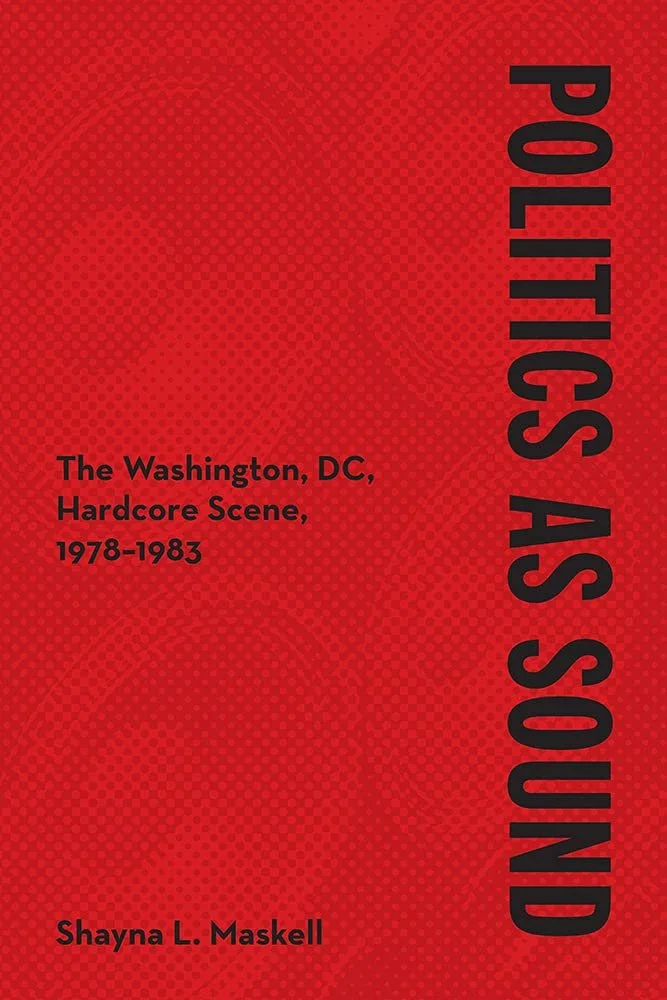
2. It’s my understanding you live not far from the legendary Dischord House in DC, that you grew up in the DC area, and that the Fugazi-era Dischord bands were a big influence on you. Can you tell us how this informed your first book, 2021’s Politics as Sound: The Washington, DC Hardcore Scene, 1978-1983, as well as how it’s informed the direction of your research overall?
Yep, I live about a four-minute walk away from the Dischord house. My kids ride their bikes home every day, passing not just the house but the small space where the label works out of. It’s insane to me that there are these two million dollars plus homes in this neighborhood with no one even knowing who Ian MacKaye is.
And to be fair, I did only know him from Fugazi originally. I was too young to have been involved in the hardcore scene growing up in the suburbs of Washington, D.C. I missed Bad Brains being banned from the 9:30 Club; I was still teething when Minor Threat first shrieked that they had better things to do than snort white shit up their noses; I never did see John Stabb shave his head on stage at a Government Issue show; and by the time I had entered elementary school, Faith and State of Alert had already broken up. But as a kid who never felt like she fit in, Fugazi opened my eyes to all these other Dischord-label bands: Q and Not U, Shudder to Think, Jawbox, Nation of Ulysses. And even more importantly, maybe, was I got to see all these bands for free at Ft. Reno in DC, where every summer they held free concert series.
Music was always how I identified myself and the world around me. Music crafted, and still crafts, my sense of time, of place, and of myself and of others. So music as transformative, as constructive and consequential, has always been my framework, and bringing that to the city I grew up around just made sense. I always feel like DC gets a shitty rap. It’s just a political town. It’s buttoned-up, conservative, doesn’t have an identity. And that’s bullshit. People just don’t know about the music from DC.
3. Tell us about the genesis of Politics as Sound as well as what the research, writing, and revision process was like.
It’s not very original or exciting, but the book started as my dissertation. I had moved back from LA to get my PhD at the University of Maryland (where they have, by the way, one of the best archives of DC hardcore in the country) and started to write in my third year of the program. Three years after that, I finally finished and defended my dissertation. After that, I had to take a break from my manuscript – I had been, for three years, listening, interviewing, writing, re-writing, theorizing, collecting – and I was done for a while. I met my husband, a hardcore kid from Richmond (with very strong and opposing opinions on DC hardcore), and that re-sparked my zeal. But it wasn’t until I got a full-time teaching position (and became pregnant with twins) that I decided to revisit the work.
Revisions suck. Having really respected music studies academics tell you what you did wrong, are missing, should have, is super humbling and definitely began a sense of imposter syndrome in me. But after some distance, emotional and physical, I knew they were right. Our writing is like our children. We think it’s perfect. But lordy, it is not. And we can finally see that as we don’t think of them/it as extensions of ourselves. I found myself liking the manuscript even more when I got to write new chapters, think in new ways, and discover new connections.
4. What place- and context-specific factors do you identify as central to the formation of—and ultimately as defining features of—DC hardcore? Could you also speak to the socioeconomic conditions of the DC scene which were notably in contrast to many of its counterparts elsewhere?
Oh man, that’s such a hard question because my immediate response is everything. And of course, that’s neither helpful nor very academic, so I’ll try to pick just one aspect for now. I think for any city, the combination of the built environment, geography, systems of control and power, as well as their sociocultural and political milieu, construct their identity.
For DC, that is both augmented by and contrasted with the city’s duality. Washington is, obviously, the political mecca of not just the United States, but in the 1980s, the world. When someone says “DC” it’s often a stand-in for Congress, the President, the Supreme Court, lobbying companies, NGOs, etc. It’s a symbol. DC = politics. (And, it should be said, politics = white, heterosexual, Christian, men.) And sure, that’s true. But there are people in the city that have nothing to do with that system; they don’t move in and out with every new administration and often have none of the power ascribed to this city. And many of those people are marginalized communities – black, brown, and working class. In fact, unsurprisingly (but important to the racial and classed aspects of DC), the city was built on and by enslaved black people and owned by white men. Colonialism, white supremacy, misogyny – all the founding attributes of our current country – were also the history of DC.
So DC hardcore was at this really fascinating intersection of all of these conditions and seeming binaries: rich/poor, powerful/powerless, city/suburb, black/white, men/women, political/personal, and even DC/Virginia. They were living these tensions as teenagers and as musicians – the privilege of whiteness and power of masculinity; the threat of blackness; the scourge of youth and the promise of community. They scorned politics but embodied them. DC hardcore was, and represented, the complicated identities of the city.
5. The era you highlight is what pretty much everyone would cite as the heyday of DC hardcore—in a sonic form that’s immediately recognizable as hardcore at any rate—and yet it wasn’t without its issues (which of course the Revolution Summer was a response to). What specific intersections and issues do you explore in the book?
My theoretical framework, not just for the book but also teaching, being a parent, friend, wife, daughter, begins with hegemony. This means, in super oversimplified terms, social control (as both an end and a process), which creates norms and standards about everything – gender, race, class, youth, etc. And not just norms and standards about everything; they are invisible ones that make it seem that is just the way the world is. My son used to have long hair and wondered why everyone assumed he was a girl. Or why in kindergarten he couldn’t wear a dress. And because they have me as their annoying mother they have learned, as almost 10 year olds, that the answer to nearly all these questions is hegemony (or more precisely, the patriarchy and white supremacy).
So that’s where I started from with DC hardcore. Where do these young men resist and rebel against hegemonic norms of race, class, and gender? And where do they, mostly likely subconsciously, actually reinforce or perpetuate these norms? And I didn’t only want to look at the corporeal aspect of that (although I do, and it’s super important – their hair, clothes, bodies) but also how their music works to resist and reinforce. How has sound as music been deployed as an instrument of social control and order? And then how has the sound of hardcore become a tool of either hegemony or subversion?
And of course, despite most of DC hardcore explicitly rejecting the idea of politics in a town where it is near-fetishized, how is hardcore a form of politics? What does it mean to call hardcore a political act? Place is also essential to this. I wanted to know how the spatial, physical, and cultural experiences of the city, mold, limit or free up hardcore as a music and a subculture.
6. What tensions, complications, and contradictions do you explore in the book and your other work on punk and hardcore? Bad Brains are fertile ground to explore various intersections, as you note in “Performing Punk: Bad Brains and the Construction of Identity” (Journal of Popular Music Studies, Vol. 21, Issue 4, 2009): “Negotiating their own racial identities, while at the same time co-producing and performing collective identities of their audiences, Bad Brains does more than create sociopolitical protest music. Using the conceptual framework of surrogation and utopian performatives, we can analyze the ways in which Bad Brains—musically, visually, and physically—perform race and recreate punk rock, while evaluating how the band, and its audience, both participate in, and often contradict, the utopian possibilities of performance.” Could you speak to this?
Bad Brains is an incredibly paradigmatic band – not just of hardcore writ large and DC hardcore specifically – but of the contradictions and complications of this particular sound, scene, and context. As one of the only all-black hardcore bands, they very much were in the punk tradition in terms of sound, appearance, and even their names. And their sound was, arguably (though not arguable in my opinion), the most influential to what hardcore was and became. They rip and shred, shriek and pound, but they do so with a technical prowess that first or second wave punk never had. This wasn’t a three-chord democracy. It was strategic warfare.
But race is a both contradictory and constructive part of their influence and their sound. The historical and cultural tradition of black music as a force of subversion and power – from the fields and the blues to the precision and exclusivity of bebop jazz – is an important way to understand how they took this nearly all-white punk (which, of course, was a mutation of rock n’ roll, which was, of course, appropriated by white people from black rhythm and blues) and made it better, harder, and faster. They flipped the racist trope of black bodies (rather than the binary of white intellects) while also reinforcing it with their near-frenetic, pugnacious performances, simultaneously reinforcing the innovation of black music and its construction as violent and a threat to society, and disrupted the image of the whiteness of DC.
And this is where utopia comes in. Not in a garden-of-Eden, never attainable perfect concept of utopia, but instead one that captures that sense of community and ephemerality. Their shows, and the DC hardcore scene, were a place where these disaffected teens came together to create new experiences, meanings, and new imaginaries of what life could be.
7. Talk to us about the notion of sonic masculinity and how this relates to punk and hardcore (and really heavy/aggressive music at large).
I think this is where the contradictions of hegemonic norms are perhaps the least muddy. The music of hardcore is at the center of this idea of (hyper)masculinity. SOA, Minor Threat, Bad Brains, GI, Faith – their music is brutal, unwavering, loud, and forceful. The texture, the timbre, their lyrics, the volume at which they play – all of this speaks to the conventional ideas of what it means to be a man: aggressive, assertive, with privilege and control. Squealing guitars, war-like drums, bellowed vocals all connote danger and power, which is societally linked to manhood. (In contrast, say, to the construction of femininity through the acoustic guitar or the flute or viola.)
And this is just a continuation of what music has always been – written by men, controlled by men, played by men. That’s not to say the sound of hardcore has always been a part of the music industry, but the music industry has always been near-exclusively men.
That anger and combativeness in hardcore doesn’t just stem from some sense of meeting culture’s expectations of masculinity, which hardcore intentionally did not want to do. It was borne of the violence of the Reagan administration, the feelings of frustration and powerlessness of being a teenager, and the physical realities they faced from military meatheads and frat-like normies in the city. So, the emotions are understandable, as are their manifestation into music. What’s important, though, is that it is ONLY those emotions men are supposed to express, and conversely, what women are not supposed to express.
8. I was wondering if you’d explain a bit about your thesis that straight edge “was always-already both a subculture and a social movement” for the readers.
Yeah, having studied both subcultures and social movements, there is this disciplinary territoriality that, I think, comes from some hegemonic notions of age, politics, and power. Subcultures are usually constructed as youth-bound. So, it’s young people who are resisting and doing so in some sociocultural way; they dye their hair, they listen to different music, they wear different clothing, etc. Social movements, on the other hand, are generally constructed more as an adult venture, something that is grounded in the gravitas of politics and “real change.” Social movements are what incite legal and social change. Subcultures, we are told, don’t have that impact. They’re just a passing phase.
But those definitions are predicated on the notion that the cultural isn’t political. And, as the feminist slogan of the 70s reiterated, the personal is political. And I mean two things by that, which I’ll link to straightedge. One is that the choices people in subcultures make are nearly ubiquitously resistance against some hegemonic ideology. In straightedge, it’s primarily gender-bound, with echoes of class and sexuality. Straight-edge’s credo, I don’t drink, I don’t smoke, I don’t fuck, pretty much sums up what society tells young men they can and should do. Drinking is the arena of football games, frat parties, and Friday nights; smoking is in the vein of Marlon Brando, the Marlboro Man, and James Dean. And the fucking, well, I think that’s self-explanatory. So, the entirety of straightedge ethos is a resistance against this demand of (white, heterosexual, middle- to upper- class) masculinity (which, yes, I know contradicts what I just wrote about the music but stay with me here). And secondly, these are indeed, personal choices. Choices made by young men who saw how drugs ruined the hippies and the music of the 60s, how drinking made their friends stupid and out of control. The choice to abstain was and is a personal one, despite the very odd alignment of Reagan’s Just Say No anti-drug campaign.
At the same time, straight edge has all the hallmarks of a social movement – it is formed by a grievance (hegemonic masculinity), within a sociopolitical context (DC in the late 70s/early 80s), and creates a collective identity (see the above ethos) and frame for their ideology (by reclaiming symbols and language). And, detouring slightly from the theory of social movements, it’s pretty hard to deny that straightedge has become a world-wide movement (despite Ian’s stated desire against such a thing).
So subculture AND social movement. But I would also quickly like to defend subcultures, even when they are separate from social movements. The disdain for and dismissal of cultural rebellion is laughable, given that nearly all social change has, to a large extent, been a function of changing popular culture. Seeing marginalized identities of people on TV and in movies, understanding different points of view through music, reading stories about people we would never have a chance to meet – all of this is an essential step in creating acceptance, acknowledgment of basic humanity, and the more-lauded legal changes in our society.
9. While finishing Please Kill Me: The Uncensored Oral History of Punk by Legs McNeil and Gillian McCain, one thing that struck me was how by the late 70s, most of the original punks had concluded that punk was dead; similarly, by 1983, 1984 at the latest, most of the original hardcore bands had concluded the same about hardcore. Punk as a sonic medium is still alive though I wouldn’t necessarily say it’s alive and well—the final wave of significance, in my view at least, crashing in the early 2000s—though the spirit and ethos of punk remain as vital as ever. Hardcore, despite a serious low ebb throughout most of the 2010s when, honestly, I thought it was going to die, is doing as well as it ever has, and has more racial and gender diversity than at any time in its history. Hardcore as a specific time and place phenomenon in its original incarnation certainly ended where you place it, but it’s interesting to me how genres have the potential to not only continue to revitalize themselves but evolve, and when they don’t, they die.
Our Band Could be Your Life: Scenes from the American Indie Underground, 1981-1991 by Michael Azerrad is an excellent chronicle of how punk and hardcore begat post-punk and early college rock which ultimately begat grunge and the late-80s, early-90s alternative explosion, and in your book you also provide an important post-script to the early days of hardcore, with two aspects in particular I wanted to commend you for highlighting: one, the influence of hardcore on metal, not just the other way around, as the oft-neglected other side of the equation, if you will, in the reciprocal relationship that continues to this day; and two, for continuing the thread of hardcore’s evolution to include metalcore, which is almost totally absent from academic discourse and study.
Are there any other lesser-known or -acknowledged aspects of the legacy of punk and hardcore that you find particularly interesting or relevant to the contemporary musical and/or cultural landscape?
I love this question. And it actually really speaks to the subculture/social movement aspect of hardcore, too. And that’s because of the concept of a life cycle in both social movements and subculture. The end of that lifestyle, the death of a subcultures is, as I cheekily call it, the Hot Topicization (ie commodification and appropriation). This is clear in punk, but equally clear in any other subculture, music-based or otherwise. If you can buy it in a store or see it on a show, it has left the realm of subculture and entered the arena of mainstream culture. For social movements, death is when their platform(s) are combined with (usually appropriated by) institutional political parties. Both of these endings are about seizing the least threatening aspects of the subculture/movement – basically, those aspects that don’t substantially change the status quo.
And we definitely have this mainstreaming, to a certain extent, with hardcore. Hardcore has never been more mainstream. Turnstile is played on the radio and won a Grammy. The Dropkick Murphys dropped in to play with Haywire. The banana costume at the End It show is the hardcore debate heard ‘round the world. You have kids calling themselves straightedge who have never heard of Minor Threat or even hardcore. So, you have a certain dilution of the music and scene in ways that elder hardcore folks aren’t too happy about. As my friend’s shirt says: Gatekeep Hardcore.
But the other death of subcultures/social movements is also a different beginning. The creation of something new. And absolutely we see that in all the genres and subgenres and new subcultures that blossomed around and after hardcore (and any other music-based subculture). But I also think we are seeing a really interesting renascence of the hardcore sound and subculture itself. A new and improved one, if you will. We are seeing black and brown hardcore bands headlining world tours, queer hardcore, transgender folks moshing and slam dancing in the pit. And these hardcore bands are unabashedly and intentionally political: free Palestine, fuck ICE, fuck the police, capitalism sucks, fascism should be destroyed. The political IS the hardcore. This is the type of inclusivity hardcore always needed but rarely had.
10. Tell us about some of your other publications in music, youth culture, and social change and your findings.
Most of my work lives in the DC hardcore arena and how it constructs and complicates intersectional identities. I just published an article on Ian MacKaye and subversive masculinity for a special edition of a journal on iconic frontmen that looked at how he created a collective identity of disaffected young manhood. I have a couple different chapters on Bad Brains, race, place, and identity. And I also have a chapter looking at these same sorts of identity-based intersectional contradictions in Riot Grrrl.
The rest of my work has expanded out into other aspects of popular culture: representations of police in children’s cartoons; constructions of Othered Jewish identities on Instagram; Dylan Mulvaney, social media, and the transphobic countermovement; racial frames and street name changes on Next Door. The throughline of all of these pieces, and of all of my research, is the ways in which the seemingly innocuous forms of everyday culture work to both buttress and challenge dominant norms and power structures.
11. Could you speak to how your research is reflected in the classes you teach, and how both your research and your background in punk music influences not just the classes you teach but how you teach them?
My favorite class I get to teach (though I shouldn’t play favorites) is an Honors class I created, Subcultures of Music. We go through the theories of music, identity, and subcultures, but then we get to dig into everything from Pyschobilly to jam bands to metal to hip-hop and of course, hardcore, straightedge, and Riot Grrrl. My favorite emails are from students who have taken that class and discovered hardcore for the first time.
But even in my classes that aren’t centered around music, I always sneak it in. In my Youth Cultures class, we read about Riot Grrrl. In my Art as Social Action class when we talk about institutional critique of museums, I bring up the DC hardcore and go-go exhibit at the Corcoran. For my Gender Representation in Popular Culture, yep, you guessed it, more Riot Grrrl. Part of me just wants these students to hear good music, but also I want them to understand the ways in which all of these concepts are linked – music, culture, gender, social change.
12. Are there any upcoming articles, books, or projects we should be keeping an eye out for?
I have a chapter on Earth Crisis, veganism, and masculinity coming out in an edited collection called Punk and the Animal and another on DC hardcore violence as utopia in Saying the Unsayable: Essays and Meditations on the Ineffability of Aesthetic Experiences. Oh, and a short essay on one of my all-time favorite punk shows in Will Boisseau’s People’s Punk History.
Not yet published, but I’m currently working on a piece on the Baltimore hardcore band End It and the racialization of place, and my larger project on Riot Grrrl and feminist visual culture is sloooowly coming along. Stay tuned!