OVERTHROW
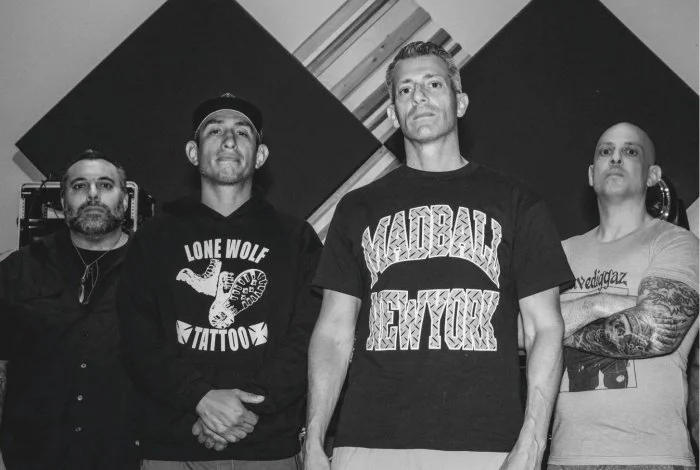
PHOTO CREDIT: FRANK SABATELLA
1. Thanks for taking the time to answer my questions! Would you please introduce yourself, where you’re from, and what you do in the band?
I am Chris, lead singer, from Long Island, NY.
2. Talk to us about the early days of Overthrow—when and how did you form, and what were the influences you were pulling from?
We formed Overthrow in 1995 while we were still in high school. We were into hardcore—the music, the scene, and the community—and wanted to be part of it by starting our own band.
Our early influences were New York hardcore bands like Gorilla Biscuits and Agnostic Front, along with the bands that were super active: Madball, Sick of It All, Crown of Thornz, and District 9. We were also really into newer bands like Indecision and Shutdown, and what was happening on Long Island with VOD, Tension*, Silent Majority, and Mind Over Matter had a big influence on us.
3. Sticking with influences for a moment, how did you discover hardcore and what was or were your gateway band(s)?
Around 9th grade I was mostly into metal, but bands like Life of Agony and Biohazard opened the door to hardcore. Our original drummer, Dimitri, was the one who really introduced all of us to the scene. VOD was the band, and from there I got into the NYHC bands like Gorilla Biscuits, Agnostic Front, Madball, and Sick of It All. I remember going over to Dimitri’s house and he’d be playing everything from militant punk to Breakdown. That was it—I was all in.
4. Talk to us a little about the Long Island scene in this era and some highlights for the band prior to disbanding.
The Long Island scene was thriving back then. There were shows every weekend, and when we started out, the PWAC was the spot—it was basically Long Island’s CBGB. After the PWAC closed, places like Dr. Shay’s, Deja One, and Ground Zero kept things going, along with church basements and VFW halls all over the island. The shows were always packed, and there was a real sense of community.
One of the biggest highlights for us before we broke up was our React record release at the Centereach VFW with Hatebreed and Candiria. That was an incredible show and is online.
5. If you’re comfortable discussing it, why did the band decide to break up in 2001?
Yeah, no problem. There wasn’t any big drama or falling out. By 2001, we were all moving into the next phase of our lives. We still loved the music and the scene, but as a band we just didn’t have the drive to keep playing. It was a mutual decision that we all agreed on, and it felt like the right time to call it a day.
6. This of course naturally leads to my next question: why, after over two decades, did you guys decide to revive Overthrow and give it another go?
We’d played a few reunion shows over the years, but our show with Strife, Shutdown, and Combust at the old Amityville Music Hall in 2022 really kickstarted everything. It felt like the right time, and we decided we needed a new song for the show. We figured if we didn’t write one then, we probably never would.
That song became “Anywhere But Here,” which ended up being the first single from the new album. The response was great, and it gave us the momentum to keep writing. Before we knew it, we had a full record.
7. 100 Demons may have gone twenty-two years between LPs, but you guys went twenty-six! Let’s get into Setting the Price, released in October 2025. What was the writing and recording process like, and what’s the reception been?
The writing process actually came together pretty naturally. The ideas just kept flowing. It was the same core four that recorded React, but this time we also had Steve on second guitar. He joined the band around the time we recorded React, and having two guitars added a lot more depth, heaviness, and harmonies that we couldn’t really pull off before.
Anthony would bring in the music and send me demos, then I’d work out the vocal cadence and lyrics. Once we got into rehearsal, everyone contributed ideas for arrangements and added their own layers. It was a really collaborative and fun process.
The recording took a lot longer than expected for a bunch of different reasons, but Setting the Price finally came out in October 2025. In the end, the timing worked out and led to some great opportunities for the band. We’re really proud of the record, and it’s been awesome seeing people connect with the songs and sing along when we play them live.
8. You recruited LIHC legend Rick Jimenez from Extinction A.D. and This Is Hell (you can read my interview with Rick here) for a feature on “What Lies Ahead.” How did that come about?
We’ve known Rick for years, and he’s been a friend of the band for a long time. He actually filled in on vocals for me on one of our reunion shows back in 2013. After we recorded “What Lies Ahead,” I felt the second verse needed something extra. I’d been listening to the new Extinction A.D. record and thought Rick’s voice would fit that part perfectly.
I reached out, he was all in, and I sent him the song. He recorded his part, and it came out great. We’ve also played the song live a couple of times with Rick joining us on stage, which has been really cool.
9. What have been the highlights for the band of this new era, let’s call it Overthrow 2.0?
That’s a great question. The whole point of doing this again was to create new experiences, have fun, and let our kids be a part of it.
As I’m answering this, we’re getting ready to head down South, then out to California, and then back through the Northeast, playing with a lot of incredible bands. To be doing this at this stage in our lives, touring behind a new record instead of just playing old songs, has been pretty amazing.
10. How does the hardcore scene—LIHC and/or beyond—compare now to when the band was first active? Do you feel like hardcore is in a good place?
I think hardcore is in a great place and as strong as it’s ever been. We came up in the mid-’90s, which was an incredible era with so many iconic bands, and it felt like you were watching the scene grow in real time. Now it feels like another great period, with a new generation of bands keeping things fresh and bringing more people into hardcore.
One of the biggest differences is how music gets out there. Back then, it was all demos, vinyl, CDs, and word of mouth. Today, streaming platforms have made it so much easier for bands to reach people all over the world. That definitely helped us with Setting the Price—people in places that probably never would’ve found Overthrow back in the day are hearing the record now.