DIN OF CELESTIAL BIRDS ‘TAKEOFFS & LANDINGS’
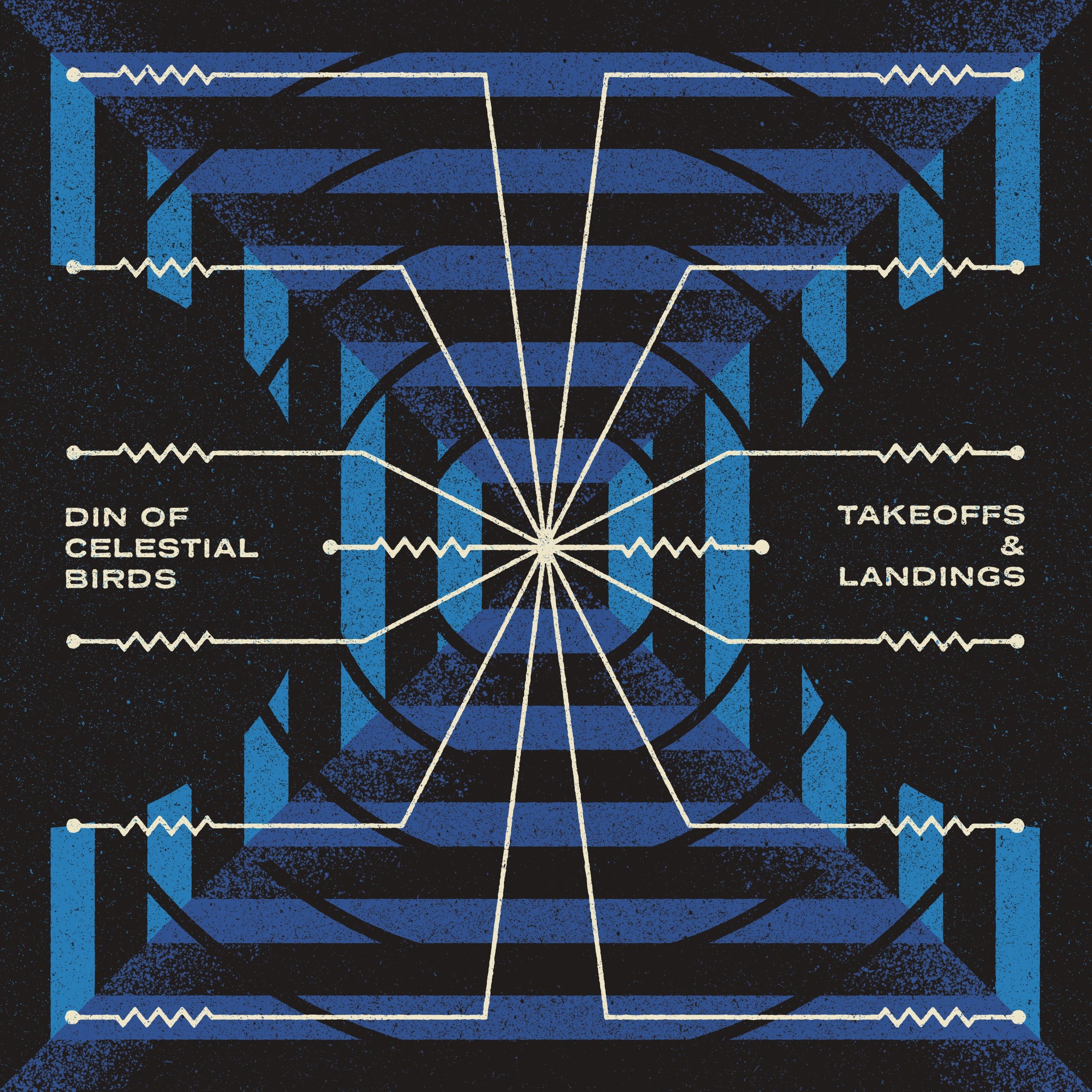
On Friday, August 7th, Leeds-based post-rock outfit Din of Celestial Birds released their sophomore LP, Takeoffs & Landings, a concept album that coheres around “the journey,” literally and figuratively, with its yin-and-yang of loud and meditative, heavy and melodic, beautiful and abrasive, frictionless and challenging, mirroring the journey of life. As guitarist and primary songwriter Andie Gill states, “each song is its own adventure,” with the individual songs—like the individual experiences in life—comprising the overall journey of the LP/lifetime.
As with the very best of the genre, there’s a transcendent quality to Takeoffs & Landings that takes one at once to places both beyond and deep within oneself. As a case-in-point, not only does the opening title track feel like standing on top of a tall hill and staring out at an expansive vista while the sun breaks through the clouds on what was previously a dreary day, I was actually taken back to just such a memory by the song, when in the autumn of 2009 I found myself standing on top of Old Sarum while a brilliant ray of sunshine escaped its gray shroud and alighted on the cathedral in the distance. I felt wonder, excitement, nostalgia, melancholy, and grief for time gone as I was simultaneously here and there. “Marmoris” produced a similar experience, although with a more aquatic bent. Both of these, the album’s first two tracks, evidence the study in contrasts that is Takeoffs & Landings: the title track with its breakdown about halfway through and “Marmoris” with its sections that reminded me of when August Burns Red started incorporating post-rock influences in their material to expand their sound. “From This Summit We Can See the Heavens & Stars,” which follows “Marmoris,” left me with a similar impression, strongest just shy of the 3:30 mark and at the end of the song, though with a little soupçon of Mastodon in the mix.
“When Suddenly…” finds the band exploring Explosions in the Sky meets Mastodon with these interesting Zombi-esque passages; the incorporation of piano on the track added emotionality, depth, and texture. “You Are My Temple” is that feeling of euphoria when you reach the mountain’s summit after hours of a grueling hike given auditory form. The largely down-the-fairway post-rock of “Migratory Patterns” is bracketed by an opening that’s sonically akin to the ticking of a giant grandfather clock on a drowsy weekend afternoon in a draughty old house and a conclusion that’s almost like Gary Numan goes post-rock. The penultimate cut “I Hope that Road Leads You Somewhere Beautiful, Somewhere You Belong” is on its own a bit less dynamic, but this is actually not a criticism as contextually it’s situated perfectly, and as for the contents themselves, the ethereal shredded-cotton-ball clouds lazily drifting across the achingly-blue afternoon sky are serene and, well, beautiful. “Second Star to the Right, and Straight On 'Til Morning” concludes the record, and it’s the one track I have some ambivalence toward, particularly as regards its conclusion: its heavenward trajectory and—to what I wanted/expected as a listener—blissfully satisfying denouement is disrupted by the band deciding to do a rendition of early Pelican meets Caspian—which on its own would be awesome, but the crunchy about-face totally knocked me out of the beatific, trance-like state the band had me in. Having said that, I can see how this may have been their intent, especially considering that it seems like there will again be a peaceful resolution before the band sonically simulates death throes to the beating of a heart monitor and then, as the music ceases, a flat-line.
This is easily one of the best post-rock records I’ve heard in a while. It really soars, and it showcases not just the band’s ability to synthesize disparate influences in a way that feels fresh against the backdrop of the familiar template of post-rock, but it’s also a master-class in effectively balancing the aforementioned contrasts, and “balance,” as Karen MacNeil wrote in The Wine Bible about transcendent Vitis vinifera, “is the linchpin of greatness.”

PHOTO CREDIT: ALEX DIXON (@alex.does.media)