AN INTERVIEW WITH DR. LAINA DAWES
4-6-261. Thanks for taking the time to answer my questions! Would you mind introducing yourself to the readers and providing a brief overview of your career in music journalism and photography as well as your academic career and their intersection?
Sure. I started writing about music as an undergrad, writing for my school’s paper on race-related issues within the Toronto area. I really wanted to write about heavy metal and alternative music, but at the time I honestly thought no one would hire a Black woman to do so. But after graduating I gave myself three years to write for free, hoping that would get my name out there and I wrote for a number of Toronto-centric alternative publications.
In 2007-2009, I was writing for a New York based heavy metal magazine, and I pitched a story to cover a two-day festival in Montreal. I met up with a local photographer, and that experience led me to start thinking about taking my own photos to go with my articles. When I started writing concert reviews for Exclaim! and Hellbound in Toronto, it gave me the opportunity to take photos, so I got some training via my concert photography friends, got a professional camera and I think my first time in a photo pit was Metallica’s Death Magnetic tour in 2009, which was a rather unpleasant experience.
As a lifelong metalhead, I always wondered why the audiences at shows were predominately white. I started presenting at journalism and academic conferences on this issue, and after contributing to a book on music writing came out, I was approached to write my own book on my experiences and other Black men and women. After that book was published, I realized I wanted to continue researching this issue from a scholarly point of view, so I applied and got into The New School for Social Research in NYC for a Master’s degree. From there, I completed an MA / Ph.D. program at Columbia University. The last school was crucial, as I met scholars whom instead of laughing at my subject interest, supported me. This really opened my eyes to the archives and that there were no scholarly writings about race and heavy metal at the time, so I had to work on a very interdisciplinary level to put things together on my own.
Heavy metal scholarship is definitely visible in the UK and Europe, but not so much in the US and Canada. So, while the topic is not new, interjecting race into these conversations is difficult but possible as within the past decade we are seeing an increase in all-black metal, punk and hardcore bands, as well as Black musicians within multi-cultural bands. With the increase of visible Black musicians, my research ideas have been strengthened, especially as how people use music to fight against racism and intolerance. A soundtrack in protesting against racial inequalities in the public sphere is very important, especially within this time of social and political inequality.
2. So I don’t want to re-hash everything from your excellent appearance on the THIS IS REVOLUTION podcast (readers are encouraged to check that out at the hyperlink provided), but I do think it would be useful for context here if you would to give us a little history of your journey into heavy music and what made you fall in love with it.
Organically, I’m just a fan, regardless of my gender and ethnicity, and was blessed to be raised in a family of musicians and people who deeply respect music. But I was able to make the correlation between internalized anger and aggressive sonic properties very, very early. I do think that because of the trauma that young Black kids get from living in a society that labels them as criminals and unintelligent, that listening to Judas Priest as a kid saved my life, and that’s what I’m interested in writing about. So as a kid I was always fascinated by images and sounds of power and aggression because I didn’t feel empowered at all, but this music made me feel powerful, gave me the internal strength to carry on, and individualize myself from the racial garbage that was constantly thrown my way. Now, as a professor, I am definitely thinking of the music more expansively by researching the sonic properties, textures, amplification and the social interactions that are just as crucial to the metal scene (right now I am more of an extreme metal fan – grind, powerviolence metalcore, etc.) as the music.
3. I think for most people who get into aggressive/heavy/alternative music, there’s a feeling like we don’t quite fit into the “norm” (whatever ultimately that is) and it’s a feeling like this music speaks to me and I’ve found my people. But one of the major things you touch on in your writing is the disappointment you felt that in what was supposed to be an inclusive haven and a rejection of mainstream normativity was actually rife with many of the same wider societal issues of prejudice. Further, it is interesting to see how there can be very rigid constructs around music genres, whether that be gender and race or even just “the look.” Today, pop music is pretty clearly the province of women, whereas rap, despite the mainstream success of many female rappers particularly over the last fifteen years, remains conceived of as a “boy’s club.” We can see the treatment of women like Megan Thee Stallion for evidence. Rap is also tethered to urbanity and blackness, and I know we could write entire books on the subject trying to unpack these things, but in short, what do you see as the expectations for heavy music, and do you think that is more rigid with metal than, for example, metalcore or hardcore? Also, would you speak to some of your experiences running up against these expectations, the prejudice you experienced, and why you felt compelled to write about said experiences?
First, I think that the mainstream metal scene is far more racist and exclusionary than the extreme, underground metal scenes. My disappointment comes from (I’m going to be a snob for a minute) suburban metal fans who choose not to socially interact with anyone who doesn’t look like them. You would think that, for example, Metallica fans who are on average, the same age demographic that I am in would be more chill, but my worst experiences have been at mainstream metal shows.
On the other hand, I find that within the underground metal scenes, people generally do not care as long as you respect the music and its community, and many tend to be more on the liberal side. That is why there are more queer and trans musicians involved, as well as white women. Underground scenes care more about the music and the musical intricacy of extreme metal than anything. Punk has always been more racially diverse, as well as the hardcore scenes, specifically in California, New York, Chicago and D.C., where there is more diversity in general. And the social aspects of these scenes are more crucial to the music’s survival than heavy metal.
I do not know what is worse – blatant racism or being used as a “token” for people so they can refute accusations of racism. I’ve experienced both. I do not write a lot about my own personal experiences, but when I do, it is because I want people to know, and hopefully do better. When my first book was published, I heard from many young Black metal fans about being afraid to go to shows, which really depressed me. However, I think that knowing that there are other people who feel the same way and have overcome their fear is important, which is why writing about these issues is so important. These experiences have also led me to interrogate the racialization of music categories and the cultivation of identity through music listening practices in my academic research, which have led to people thinking that, for instance, Black people should only listen to hip-hop, and whites “own” rock and heavy metal. The world is big, life is short, so why is it that we demand people only listen to and participate in music created by people like them? And obviously this is very hypocritical, as white folks listen to just as much hip-hop as any ethnocultural group. I would also mention that women are just as guilty of harassing black folks at shows, too (thinking about the time I almost got my ass beat by four white women at a Crowbar show in Texas).
4. It’s been interesting for me to see over decades now in alternative and heavy music some of the shifting racial and gender dynamics within these subgenres, and, to wit, some of the persistent rigidity. A couple examples would be how in the metalcore and especially deathcore scenes of the late 2000s, there were actually a ton of young, usually teen, female participants, although not commonly in the bands themselves. That completely dried up in no small part to the hostility and misogyny these young women experienced, but post-COVID, particularly in hardcore, that has changed dramatically, including both fans and bands. Hardcore generally has become in the last half-decade much more racially and gender diverse, although the presence of black women in particular remains rather scarce. Clearly the rigid expectations of what genre participants “should” look like persists: UK duo Nova Twins even named their 2020 debut Who Are the Girls? in response to the fact that they were typically the only people of color on bills and would frequently encounter skepticism that they were rock musicians when they showed up to venues. The discourse around Hayley Williams of Paramore when she was married to Chad Gilbert is another example: I can’t count the number of times I read that she couldn’t possibly come to have discovered and enjoyed hardcore on her own, it must have been Chad’s influence. I also witnessed a ton of racial gatekeeping around the “trap metal” and “emo rap” phenomena, where mostly young men of color were pulling heavily from metal, emo, and alternative and blending it with rap. The expectation from many metal fans was that there was no way they were “real fans” of the music they were citing as an influence. This is a long walk for a short drink of water to ask: how does this accord with what you’ve witnessed over the years, and do you think things have gotten better?
Err, no. It’s hard to generalize, though. I once had a horrible interaction with an older metal musician online, for a very stupid reason. The gist of it was – or what I observed, is that there is a lot of resentment from older metal musicians towards hip-hop, Trap metal, and Nu-metal because there are bands in these scenes that are more financially successful and were promoted / more elevated within mainstream music industries than they were. The fact that someone they hate and see as being “beneath” them is making more money than them is a bridge too far! On the other hand, this is not stopping anyone from making music and creating these really cool hybrids. With the online accessibility of discovering a plethora of new music for free, it is natural that the younger generation is inspired and wants to create their own thing. But this is similar to the mainstream metal vs. underground, extreme metal thing: The former will hate it, but the latter will respect the creativity.
We are currently living in a world in which misogyny is rampant, so while there are more women involved in these scenes, things have not changed so much right now, I imagine, as there is this false, yet normalized assumption that young men are being “discriminated” against because they are losing their material supremacy. Because of that, young women are an easy target for their ire. On a side note, a number of Black women metal fans have spoken about how much Hayley is an icon to them, because she was the first woman alternative singer they saw when she played the Warped Tour in the early 2000’s. And she speaks her mind!
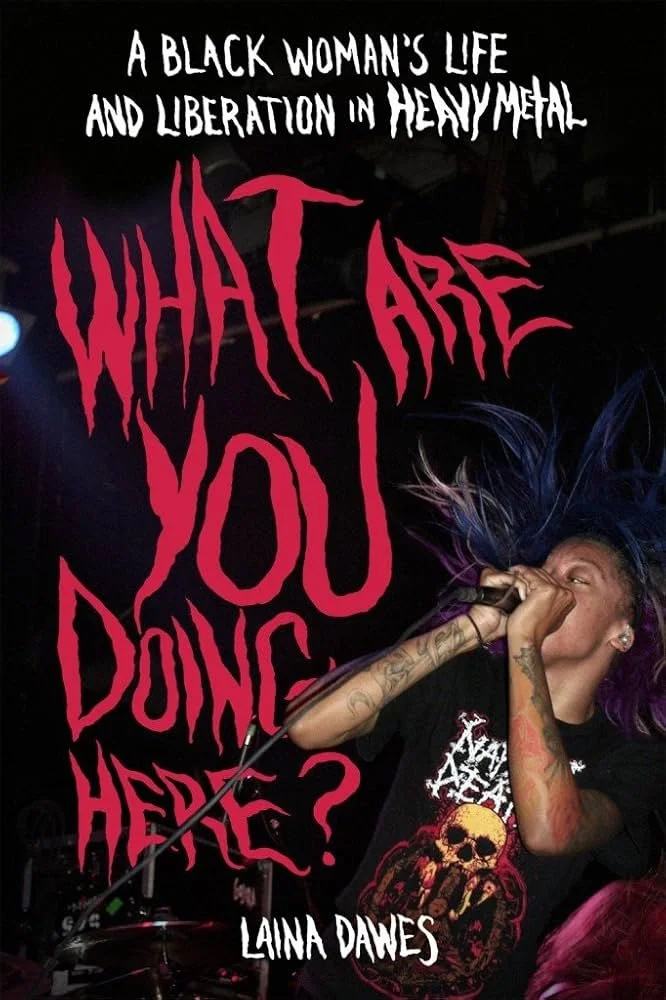
5. Tell us, if you would, a little more about your book WHAT ARE YOU DOING HERE?: A Black Woman’s Life and Liberation in Heavy Metal. How did the book come about and take shape? Who did you interview and what were their experiences in a nutshell?
I wrote the book when I lived in Canada, which made trying to get interviews with local fans and musicians very, very difficult. I had the proverbial door slammed in my face, and was not taken seriously at all when I initially reached out to my own contacts I had cultivated through my journalism work. Fortunately, my publisher Ian Christe had assisted in helping me land some of my interviews, and then, through word-of-mouth, it became much easier.
I must note that because I was covering shows, as well as photographing bands at American metal festivals, I did a lot of the ethnographic research then. I have to give a shoutout to Sean Palmerston, who now manages the band Sacrifice, Fred Pessaro, and David Hall who at the time, ran Handshake Inc. as if it wasn’t for them, I wouldn’t have gotten backstage access to a lot of cool metal shows, as well as photo and press passes. I used to call myself the “spook who sat by the door” because I was always on the outside, peering in.
Americans were 100% more willing to be open and honest than the small handful of Black folks in Toronto, some who turned down interviews because they were afraid of what “people would think of them,” which in hindsight says a lot! I really wanted to connect with other Black women metal, punk and hardcore fans, and I still keep in touch with many of my interviewees to this day.
I wanted to reach out people in the industry that would give me a 360 view of the metal scene, so that meant musicians, fans, fellow journalists, PR folks and tour managers. One of the biggest people I contacted was Skin from Skunk Anasie, who agreed to be interviewed for the foreword. In the second print of the book, I met Phil Anselmo in Texas, and I included that story, which I felt was really important. He was so gracious with his time, read the chapter I had written about the band – which was not that nice – and spoke to me about it. I also interviewed Alexis from Straight Line Stitch, Militia Vox, and Tetrarch’s Diamond Rowe at a time when the band was still in Atlanta and she must have been barely 20 at the time! I was more interested, though, in speaking to the fans because they really helped me shape what was relevant, and what was not. I should add that prior to writing a chapter I spent six months doing informational interviews, talking to a lot of white metal musicians just to see what they thought about race and gender in their scenes. That was super helpful.
6. What’s the reaction been to your writing about these issues within the heavy music community? Has there been much push-back, denial, and/or skepticism? What about, conversely, some gratitude for highlighting these issues?
Umm, for the most part, good, but I nearly had a nervous breakdown when the book first came out. I got hate from people whom I thought were my friends. I had other people try to scam me, use my name and book to promote theirs, and a couple of Black male metal folks who essentially said I put the Black community on blast, and that I should have written about men rather than women. I love my dad, but I honestly do not think he would have read the book if I hadn’t been interviewed by NPR. White people…again, mainly positive, but the resistance to my book was really bizarre. I met one person who had read the book but he said to me, “oh I assumed you were white,” when my face is on the back cover. That made no fucking sense to me and I still bristle over that.
One of the most aggravating things was not being taken seriously, as though my fandom was a hoax and I inherently, as a Black woman, knew nothing about what I spoke. One journalist reviewed the book and said it was irrelevant because he was a white man and didn’t understand. I was pissed, he knew it, but I was even more angry when I presented at a heavy metal conference and festival and the journalist in question had asked a mutual friend if I would beat him up when I saw him. In hindsight, I should have. Part of me was disappointed, but it made me stronger in my resolve than ever before. I had people who laughed in my face – both Black and white – when I told them what the book was about.
However, the book was more successful than I thought it would be! But overall, I learned that there is a general distain for Black women, and when you don’t fit into their narrative, they get angry.
7. Would you please tell us about your journey into academia and how that has unfolded?
It came from people assuming that I, from a young age, was an idiot. I never did well in public school, had horribly racist teachers and classmates, and while high school led me to think about writing for a living, my school steered me into the service industry. I failed a grade and got kicked out of the school, and spent a year in a special education class because of the assumption that I wasn’t going to amount to anything substantial in life and in hindsight, this was because of my ethnicity, but I was told that I was the problem. I had to prove myself and claw myself out of that mess, as from the age of five or so, I knew that I was on my own, and from the age of eight, heavy metal gave me the power and drive to succeed.
These assumptions about intelligence and blackness were and are not rare, as a Black friend in my high school who expressed her interest in going into the corporate world was told she should find a job as a cashier, despite her having an A average. In hindsight, growing up in an all-white and rural environment didn’t help with my self-esteem, so I did not take the traditional route to university. I was the one who wanted to attend university – my parents were reluctant. I eventually went to grad school, got my PhD and went into academia because I wanted to learn more, work on my academic writing style, and to utilize the environment to bolster my thought process so I could write and research scholarly publications. I was also interested in teaching at the university level because I wanted to ensure no student would have to endure what I did. A lot of the work I do is to ensure no one has to experience the self-hate and shame that has plagued me for most of my life.
8. What are some recent projects you’ve been involved in and/or some future endeavors we should be keeping an eye out for?
My upcoming book, Engaged Aggression: New Ways of Thinking About Black Music is my main focus right now. The central focus is looking at how extreme metal and other aggressive genres can help Black youth with making sense of the world, specifically to alleviate the internalized anger and rage that comes with systemic racism. Black people, specifically youth, are taught not to fight back, to be the “better person” and walk away from conflict (which eats you up inside), but because of my experiences I know that holding things in for fear of being reprimanded, or getting arrested, causes depression and trauma. Metal got me through as a teenager. I was able to expel the hate and anger I held in though listening to the heaviest shit I could find. So yeah, finishing up my manuscript!
9. Okay, a pair of fun questions to close us out. You’ve been granted magical powers to bring five bands or artists past or present, living or deceased, together, at their peak, for a one-night show only. What’s the lineup?
Neurosis, Melvins, Entombed, Weekend Nachos and Converge.
10. If you were stranded on a desert island by yourself and could only have five albums with you to listen to, what would they be and why?
Judas Priest, Screaming for Vengeance: Favorite album of all time. My favorite band of all time.
Neurosis, Honor Found in Decay: This particular album really resonates with me. I think this band really touches on what it’s like to be middle-aged, dealing with conflicted emotions but finding the internal strength to always move forward. Every time I’ve seen this band live – many times – I leave in tears. So good.
Converge, Jane Doe: Simply pristine. LOVE this band. And the production is stellar, as well as on all of their albums. And one of the best live shows I’ve ever seen.
Public Enemy, Fear of a Black Planet: I’ve been listening to the first four albums nonstop for a month. Chuck D’s commanding presence is always welcome, and they really forecasted the current issues we are currently experiencing. Definitely my favorite hip-hop group.
Weekend Nachos, Still: When I first heard this album, I felt like my life suddenly changed for the better. I’m a huge powerviolence fan, and every track on this album totally rips.