BIRTH (DEFECTS)
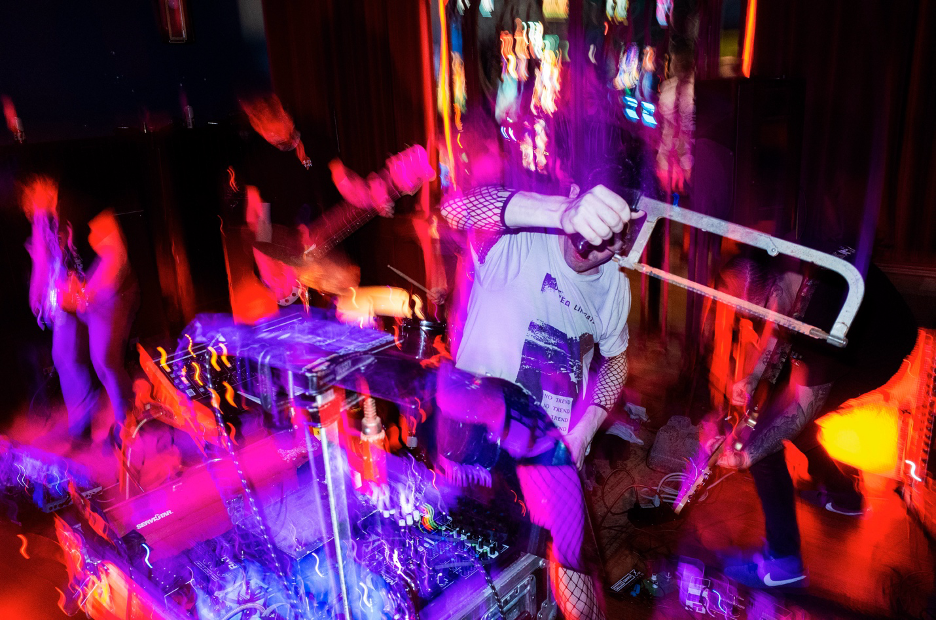
PHOTO CREDIT: SAM LEVINE
1. Thanks for taking the time to answer my questions! Before we jump into it, would you be so kind as to introduce yourself and what you do in Birth (Defects)?
Rob: I’m Rob, and I play guitar and make noise with too many pedals and broken amps.
Ian: I’m Ian and I played bass from 2013-2015, and then 2019-onward. I also did some mixing and mastering for some of the early tape releases.
Joey: I’m Joey and I play uhhhhhh junk metal and synths. I also do a lot of the art (if it looks clean it’s Terrence, if it looks fucked up it’s me).
Sean: I’m Sean, vocalist and play electronics.
2. Would you please provide a little context about the band—where you’re from, how you formed, etc.?
Rob: We come from the Baltimore-D.C. area. Sean and I were working on some of the earliest material back in the late aughts. Then in late 2013, we decided to go for it and put together a full band. “Demands” was the only track from those early sessions to stay on, which we eventually recorded and released on the first cassette split with CP/M and then rerecorded with Shaun Sutkus from Perfect Pussy and released on our second 7” single.
Joey: Okay, the rest of them are from the Baltimore-D.C. area. I’m from Delaware originally, and after moving around a bit ended up in Baltimore (the Delaware Catholic kid to Baltimore noise freak pipeline strikes again). I got asked to join B(D) for a farewell recording session by Rob after we’d been working on a new band together. Sean made the invitation official when my other project Bloated Subhumans played with Drunks With Guns in Baltimore. I think. Maybe I have that timeline wrong.
Sean: I grew up 20 minutes or so outside of Baltimore. Many years ago, I met Rob when I started my first record label. I had released some material from an old band of his. We had been working on music together off and on for years. Around 2013 is when it felt like it was right to work on something consistent. The band really started out of absolute necessity. I think ultimately the band saved Rob and I in different ways. We also knew there was a shelf life for this band. Part of that had to do with where we were in life, our ages, and that the best bands knew when to quit.
3. Did the band have a kind of mission statement at the outset, and if so, what was it?
Rob: Initially, it was to play loud, obnoxious music. But I always wanted our songs to be memorable in some way, so we took a lot of care to differentiate tracks by trying different approaches. The riffs were central to that effort. We experimented with every idea. We left a lot on the cutting room floor.
Ian: BOMP BOMP NANANANA BOMP BOMP SCREEEEEE
Joey: My personal ethos in every project I’m a part of is that music should always be as annoying as possible.
Sean: We really wanted to do something that would lure people in and then try to challenge them as much as we could within that framework. Catchy riffs were critical to that. I had zero interest in just being a by-the-numbers noise-rock band, which can range from leaning on noise as a crutch to cover up piss-poor songwriting or using noise as a gimmick because it’s a “vibe” or something.
4. What was it about alternative/abrasive music that not just drew you to it in the first place but made you want to play it?
Ian: See above.
Joey: It’s the only music that makes sense to me, the only music that speaks to me. Okay, that’s not entirely true because I like some things with melody. But being trapped in a hostile, overstimulating, industrialized world, noisy music offers a sense of control. I think it was Sleazy (or maybe it was Chris?) from Throbbing Gristle who said that he realized that TG weren’t making anything new, they were just copying the sounds they heard around them. It’s a release.
Rob: I think it’s the intensity that first hooked me, how relentless and punishing it can feel. Done well, noisy, harsh music is a sort of endurance test, but it also is a tapestry of textures for the ear. I love how chaotic and unpredictable it is.
Sean: Pretty much the same reasons as everyone above has stated. I think also for me, it was this idea that you could find more in less-abrasive music if you understood and welcomed abrasive, avant-garde/experimental music.
One of my earliest noise memories is being introduced to C.C.C.C.’s Flash when I was maybe 18 or so by Jason Urick, who used to work at a record store in Baltimore. I was kind of on what the standard Merzbow path is now; C.C.C.C. was a revelation because -- even more so than Masami -- it felt psychedelic (not that Masami wasn’t -- I just hadn’t dug that deep in his discography at that time), I got lost in that album. C.C.C.C. and Hijokaidan were huge when I was younger in terms of opening me up to the limitless of noise. I then went on to discover RRRecords, and all bets were off.
5. Fictional Days is slated for release May 22nd, hot on the heels of Will Shatter Rides Again. What can you tell us about these releases?
Ian: I was really excited to get to come back to the band to record Fictional Days and join the band on tour, where we recorded the tape. The unreleased tracks from pre-Deceiver were the last things I recorded with the band before I had to quit the first time, so I’m selfishly happy they’re getting to see the light of day.
Joey: Fictional Days is a compilation of outtakes and unreleased tracks, plus some covers. Will Shatter Rides Again is a live recording I did of our show in Newark, DE on the 2025 tour. Sean, for better or worse, gave me total creative control over WSRA, so it’s much less modern-art-exhibit and much more irreverent-tongue-in-cheek-for-the-freaks. I love serious art and I do make serious art, but B(D) brings out the snotty punk in me.
Rob: We had always wanted to release a chaotic live album in some form, and Joey had set up his Zoom handheld recorder for (nearly) every show on our final tour last year. We picked the performance from Newark, Delaware, at The Newark Bike Project, where our friend Robby runs shows, and that became Will Shatter Rides Again.
Fictional Days came out of the process we went through finishing Deceiver / Mirror, an album that we had recorded years earlier but left unreleased because the band imploded not too long after. So while we were revisiting those songs and adding some new overdubs, Sean had the idea of putting together a series of covers representing our varied influences, like The Comsat Angel’s “Postcard” and The New Flesh’s “Scapegoat.”
After recording them, we realized that we had more than a half-an-album’s worth of material, so we dug up unreleased songs from our first recording session with Nick Skrobisz to fill it out and give listeners a peek into those early years. A collection of influential covers and unreleased material felt like a great way to end the band.
Sean: To add on to what Rob said above, once we had a rough idea of what this release could be, I wanted us to work with people that I had only dreamed of because I knew this was going to be the actual end of the band’s recorded output. I had sort of viewed this release as a love letter to the people and bands that influenced us.
Having a legend like J. Robbins record these covers was one of those dreams. Jawbox was one of those bands when I was a teenager that I looked up to. There was a certain focus J. had with that band that I always respected. Jawbox was a smart pop band, and I mean that as a huge compliment.
Drum sound is extremely important to Birth (Defects). Not only did we get lucky with every drummer we’ve had, much of our recordings underscore that. I knew J. had a big room for drums. Bret Lanahan (from Dosser and Roomrunner) played on some of these covers. He’s the kind of drummer that, as we joke within the band, comes from the school of “Grohl.” Bret is an amazing drummer. He’s a “one take” kind of guy but hits hard as if it’s the last take he can do, and he’s going to put everything he can into it.
Speaking of that world of drumming, having Barrett Jones mix this record was a dream of mine since I was 13 or so. Like many, I got introduced to him via that first Foo Fighters record, which, if you listen to the deep cuts of that record, for a mainstream record, it’s not a standard “grunge” or “post-grunge” record.
I’m one of those people, especially when I was younger, that if I loved something, I dove as deeply as I could (this was mostly pre-internet as well), so hearing about what else Jones had done got me into bands like KARP or even Autoclave. As with someone like Hijokaidan, Jones introduced me to another world of music that would later become part of the bedrock for stuff I released on my labels, and what B(D) would become. Jones knew exactly what we wanted to do with this record once we sent him the unmixed material.
I want to take this time to just quickly mention why we covered who we did. Sonic Youth and Nirvana are obviously the most natural for this band. I am a big believer in not shying away from where you come from. Some of the more obscure-ish material from those bands are clearly the most interesting to us. Although I feel like for every cover, like a Nirvana cover or something, you should also prop up bands that maybe are less known.
The New Flesh is, for some of us in the band, one of the most important bands to come out of Baltimore. In the early ‘00s, there was a certain crop of bands that were kind of all friendly, but there was no real distinct sound. Charm City Suicides were a band that kind of felt like you could be in a punk band, but it didn’t have to sound punk. So, you had bands like Economist, Double Dagger, Stars of the Dogon, and The New Flesh all just taking different routes.
The New Flesh were doing this sort of Drunks With Guns/Pussy Galore/Flipper thing that no one was really doing at the time. This was the kind of band where every time I saw them live, it felt like they were all at the end of their ropes. Nothing mattered. Nothing. Nihilism seemed like the only thing that made sense to them. They used it to their advantage. Because of that, though, a band like that couldn’t really last. You knew that seeing them. There was a desperation in those New Flesh songs that to this day sticks with me. Covering “Scapegoat” may have been the most I ever pushed myself vocally -- to the point where, if I recall, was the last song I tracked with J. And after it was over, I flat out said I couldn’t ever do that again. It scared me, so I knew it came out okay.
6. What went in to the decision to have these two releases nearly coincide as the final two releases from the band, and why these particular ones and their contents?
Rob: The releases coinciding is merely a consequence of production delays. We originally intended to have Will Shatter Rides Again as something for fans in between the releases of our debut album, Deceiver / Mirror, and Fictional Days, but circumstances outside of our control pushed it into the release window of Fictional.
Joey: Part of why WSRA got delayed is that I had a mental health crisis and didn’t finish the art in time. Terrence is gonna kill me when he has to assemble all these. But hey, that’s showbiz!
7. Is there a feeling of melancholy or even grief that comes with that word “final” in this context?
Ian: Coming back from the dead once is more than most get.
Joey: I’m sure Sean will say it’s a relief because from what I understand, and even in my brief time in B(D), it’s been particularly tumultuous. For me, I think the grief came after the last show about a year ago. But it wasn’t so much mourning the lost band as it was grieving the return to reality (i.e. back to my job). I had a lot of fun and I kind of wish this lineup got to write some material, but I’m happy to be focusing on the new band Rob and I are working on, Crimson Behelit.
Rob: Not for me. But not relief, either. I’ve been kicking around with this project off and on for a long time now. When we first revived the band, the original intent was to simply release the Deceiver album as it was without much fanfare at all. Sean -- although initially reluctant -- decided that if we were going to do this, we should go all in. Fictional Days is the fruition of that. So I’m really excited to see this through and release these songs and end this band on our own terms. I’m looking forward to future projects, like Joey and mine’s mutant-hardcore band Crimson Behelit, plus a lot of other ideas I’m still working on.
Sean: Everyone in the band knows where I land on this. There is a relief. The paths we took seemed to always be the most difficult. Some of that was our choice; some of it was things out of our control. For the few people that followed this band, maybe that was part of the charm.
8. Looking back, what were the highlights of the band’s career?
Ian: I’ll never forget the time in Philadelphia when Rob’s amp blew out mid-set, leaving Eric and I to drag out an impromptu psych/noise jam for maybe 10 minutes while amps got investigated and swapped out.
But being completely honest, the show at the bike shop in Delaware, as heard on Will Shatter Rides Again, may have been our best live set as a band. (Mayyyybe Ithaca? Maybe.)
Joey: I wasn’t there for this, but an older lineup got to play with Hijokaidan. It doesn’t get much cooler than that. As far as highlights from when I was in the band (skipping the joy of making art and the thrill of our live sets and how great it was to tell stupid jokes back and forth with everyone), one big one was the promo photos we got forced into doing by Reptilian. Let me clarify: the promo photos themselves were not the good part. I think that promo photos are an act of self-debasement, a humiliation ritual. My compromise was wearing a paper bag over my head. And then one of those photos ended up in the Washington Post (I guess Bezos will put anything in his paper). I also thought it was funny when I said inflammatory things in interviews and they got cut out.
Rob: We always made it a point to only accept shows that we would attend ourselves if we weren’t playing, and we were lucky to consistently play shows with amazing bands. We got to open for Godheadsilo, Unsane, Negative Approach, Hijokaidan, and UXO. I’m probably forgetting some.
Traveling to Electrical Audio in Chicago to mix our debut album with Matthew Barnhart (RIP Steve Albini). Flying to Seattle to work with Barrett Jones, who recorded KARP and Pussy Galore. All the tours and recording sessions we did together. Those’re memories I cherish.
Sean: Along with what everyone has said, I’m just lucky I got to work with such great people. Even those who aren’t in the band anymore. Everyone was important to this band. Our first drummer, Tim Phelps, who actually helped write some of the very early output, is still someone we keep in touch with and who has been a big supporter of what we’ve done as the band progressed. I do want to take this time to talk about the band members.
Jeff Byers and Chris Morawski are an important part of this band, and without them, the last album would not have been the same nor as good. Some of the most bonkers and interesting sounds come from the both of them. They made this band better.
What Erik Wisler, our second drummer, contributed cannot be understated. Not only is he one of the most unbelievable drummers I’ve had the honor to play with, he’s one of the most down-to-earth and nicest people.
Bret Lanahan stepped in when Wisler exited the band. Without Bret I’m not sure where we would be.
Joey really pushed us to go to our most extremes. Without Joey I don’t think the last record and Fictional Days would be as interesting. They really pushed us to go outside our comfort zones.
Jake Reid played with us on our final American tour and obviously on the live cassette. It was such an honor to share the stage with him. He’s played in some legendary bands like Screen Vinyl Image, Alcian Blue, and Skywave to name a few. I asked him to join us thinking there was no way he would say yes, he did and he added a dimension to our live shows that somehow made us sound even louder and more impactful.
Matt Buie, our final drummer, stepped in right before we broke up the first time. He is one of the nicest and wisest people in music I have ever met. He is grounded in ways that I completely wish I could be. He is one of the main reasons we can finish the band the way we all want to. Without Matt, I do not think we would be even talking to you now. He is a great drummer, but even more importantly, he is a wonderful person.
As far as memories go, I have one that will stick with me forever ….
When Albini passed (he was going to mix our last album and passed away weeks before we were supposed to get together), Rob and I weren’t sure what to do. Maybe this record really should be shelved. I reached out to our friend Eli Kasan (who plays in the band The Gotobeds) just to get some advice on what we should do. A few years prior, his band recorded at Electrical Audio with Matthew Barnhart.
He encouraged us to keep the dates we had at EA and maybe work with Matthew. I ended up calling Matthew and having a good 90 minute or so call with him. I knew that we should move forward with him and EA, and I’m so glad we did.
Barnhart said he would still do a lot of the things Albini was going to do, that includes mixing everything to tape. At the very end when it was all finished, he handed me those tapes to hold. Being at EA at that time was heavy as it was for everyone.
There was this wave of emotion that I couldn’t hold back. Being there and working on a record was a dream I had as a teenager. I just remember turning to Rob while holding the tapes in my hands saying over and over, “We did it man, we did it. I can’t believe we did it.” I had tears in my eyes. Everything hit me at once. All the great things, Albini’s passing, meeting a friend for life like Barnhart, finishing this with basically someone I call my brother. I couldn’t believe it then and still can’t. That is a memory I will have until the day I die.
9. Do you think about legacy as regards the music, and if so, what do you hope the band’s will be?
Ian: I hope one day to be remembered as the tallest noise rock bassist of all time and as the third-best King of England.
Joey: We’ll go down as C-List noise celebs.
Rob: I don’t. This is going to sound selfish, but I play music for myself and because I enjoy doing it. If other people also enjoy what I’m doing, that’s gravy.
Sean: We made some good guitar-based music.
10. Any last words for the readers?
Ian: Don’t panic.
Joey: Tell your parents about how they hurt you before they die. Torrent HD rips of anime from nyaa dot sii. Buy the records and tapes and CDs you’ve always wanted because life is fleeting and there is joy in having historical artifacts that inspired you.
Only go see your friends’ bands if they don’t suck. And if they do suck, heckle them. Also heckle them even if they’re good.
Make whatever art you want and have faith in your art even if people don’t like it (especially if people don’t like it); if you don’t believe in your art, why should anyone else?
Not everything is for everyone. Fuck the audience. Fuck show promoters. Fuck local bands. Fuck people who view art as content to be consumed. Gatekeeping is good and is how subcultures keep out people who want to water them down.
Tell the truth to your therapist even when you’re in the wrong. Call out of work when you just can’t take it.
Be a pervert and own it unapologetically.
I before E, except after C.
Wander into the woods alone to just exist every once in a while.
Free Palestine.
Listen to Crimson Behelit. Don’t listen to Chat Pile.
Sean: It’s ok to make music/art for yourself and just a few people. Not everything needs to be known to everyone.