HardLore: The Best 2000’s Hardcore Band Tournament Bracket Exclusions
1-30-26
Recently, the excellent podcast HardLore posted their 64-band tournament bracket and subsequent episode to crown the best 2000s hardcore band. I was delighted, as this is my "graduating class" of bands, if you will, and actually I thought they did as good a job as can be expected given the sheer volume of great bands that were active during that time period. The guys were spoiled for choice. Naturally there had to be a number of exclusions, which Bo and Colin readily acknowledged, and this feature is not about quibbling over who got in or didn't or who won certain matchups or didn't (though those are fun conversations), but rather to highlight a number of bands who, in my view, also warrant inclusion consideration. Like their bracket, this list is not even close to exhaustive, though because I love that era so much and there were so many great bands, I am going to geek out a bit and include a fair few of my favorites who, like Aaron Lewis, found themselves on the outside looking in. Even still, there are literally dozens of bands I trimmed from my brainstorming list, so you can see what an ask it was for them to settle on the sixty-four they did. There is no bracket here, but it's my hope that the list sparks good conversation and debate, enables those of us who were there walk down memory lane, and potentially introduce some "new" music. Below you'll find first the HardLore bracket (you'll have to zoom in a bit in the mobile view, my apologies) and then the video of the episode, followed by some more inclusion discussion and, finally, my list of bands in no particular order. I do hope you'll enjoy reading this as much as I enjoyed writing it!
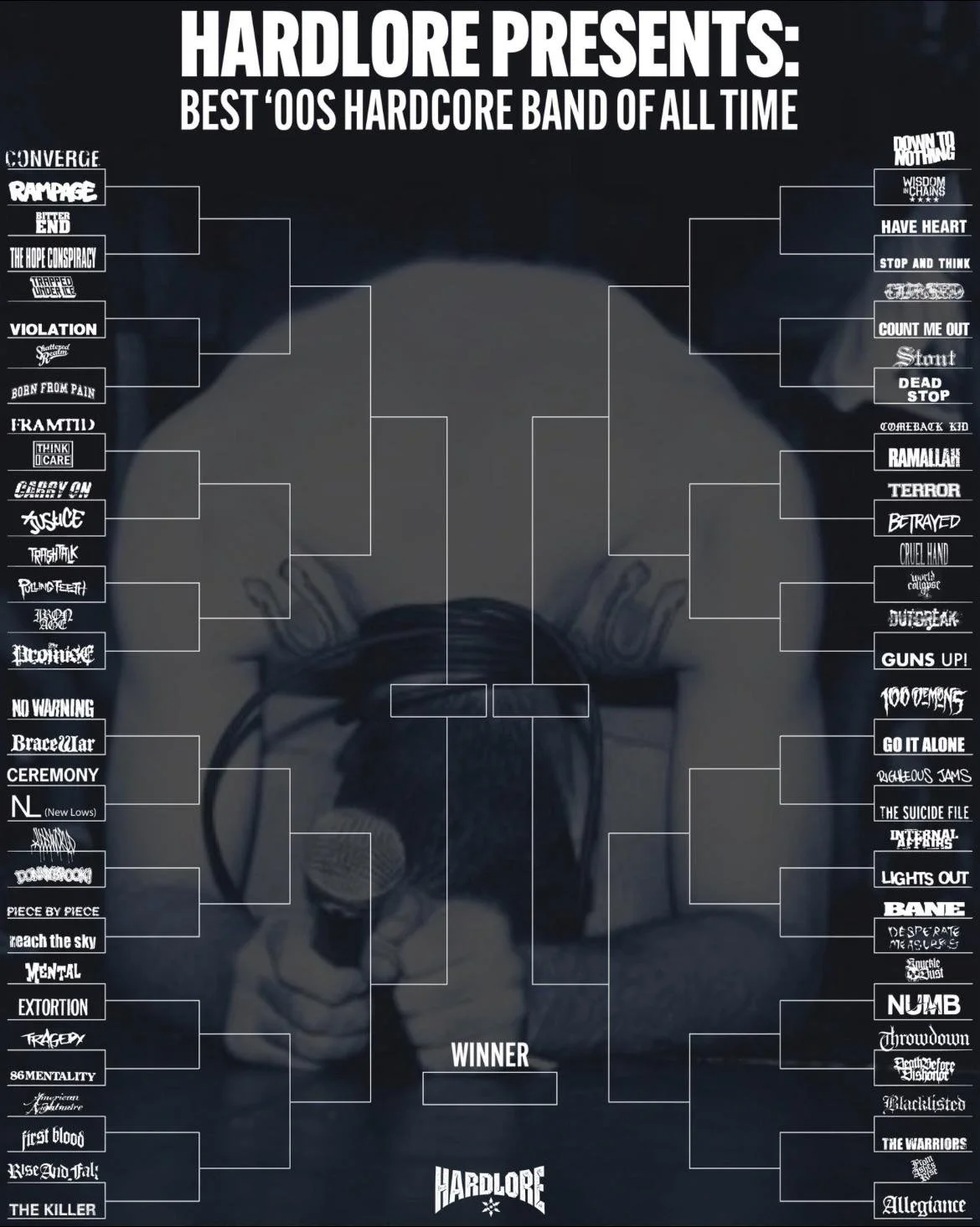
In or out? My first reaction on seeing the bracket revealed was shock and dismay (yes, I'm being hyperbolic) at there being no Foundation, but it was really in 2011 upon the release of When the Smoke Clears that they leveled-up both in terms of the album itself and in terms of popularity, or hype, if you like. I remember reviewing Hang Your Head in 2009 for Decoy Music and noting that although it was a good album, I got the sense that it was one of those throat-clearers, where the next one was going to be a "holy shit!" release. I was correct. Defeater is another band that started in the 2000s but really blew up in the decade following.
I'm sure they considered the Acacia Strain, but though they in many ways were and are obviously a part of the hardcore scene, they really carved out their own niche that sat in the middle of the Venn diagram of hardcore, metalcore, and deathcore. Along similar lines, I thought about the easycore bands like Four Year Strong and Set Your Goals that came out of the hardcore scene, but, like metalcore, that really became its own thing. Alas, unlike metalcore, it fizzled out after a couple of years, but with the MySpace deathcore revival upon us, you never know, maybe it'll come back!
Another set of bands I wasn't quite sure what to do with were those that like the pioneers of hardcore such as Minor Threat and Black Flag are claimed by both the hardcore and punk scenes. For their 90s bracket, the HardLore guys included AFI, whose 90s output definitely straddles this line. More for space reasons and less because I'm concerned with being a genre policeman, I opted to gift the punks incredible bands like Paint It Black, The Bronx, and The Nerve Agents. You're welcome! Two other bands I thought about but ultimately decided against as I felt like they didn't quite fit cleanly enough in hardcore were Cancer Bats and The Ghost Inside. Hatebreed was obviously in the 90s episode, and their seismic impact on hardcore during that decade cannot be understated, but—hot take incoming?—I think the three records that followed Satisfaction is the Death of Desire are actually better and the 2000s were when they, like Converge, became a transcendent force in their own right. The last piece of housekeeping regards the fact that we all have our own taste and, yes, biases, and consequently there was a reason we didn't see bands like The Carrier, Verse, Ruiner, or Modern Life Is War in their Field of 64 (I was surprised they didn't include The Mongoloids or Bad Seed given said taste). This list will conform to my taste, but I also think that, nevertheless, each band is important in understanding and discussing the 2000s scene.
So, in the words of Jimmy the Driver in Made: "Where to?" Where women glow and men plunder, to a land synonymous with metalcore and with a band featuring the brother of the biggest and most important band in Australian metalcore, Parkway Drive: 50 Lions. One Australian band made the HardLore Field of 64 in Extortion, but there are definitely other contenders from this era, such as Miles Away and Carpathian. But 50 Lions…I fucking love 50 Lions. 2007's Time is the Enemy was the record that got me hooked—it's chunky, and the production is booming almost to the point of overwhelm. 2008's split with Down to Nothing is must-listen material, the relationship between the two bands formed on DTN's trip to Australia. I don't know that 50 Lions ever got much traction Stateside, as I didn't hear their name basically at all outside of my circle, but that's not an indicator of quality, as Time is the Enemy, that split, and the 2009 self-titled EP with a pair of re-recorded and beefed-up tracks from their first LP, 2006's Nowhere to Run, are all top-shelf. They have plenty of other very good post-2000s material as well.
Reign Supreme. When I was doing my previous website, I also made YouTube-exclusive content, and one of the things I did was "face off" against a guest in drafting bands or records from particular genres or labels (the draft was another idea I stole from HardLore!), and one of my favorites was when I had a close friend join me to draft Deathwish, Inc. releases. The number one overall pick? Reign Supreme's 2009 Testing the Limits of Infinite. 2008's American Violence EP's title accurately encapsulates this band: pure auditory violence from, to quote Paint It Black in "Four Deadly Venoms," "the city that shoves you back." Testing the Limits of Infinite has it all: gang vocals aplenty, ferocious vocals, nasty breakdowns, great track sequencing, and even strategic and highly-effective uses of melody. Though 2013's Sky Burial EP falls outside our timeline here, it is worth noting that it is some of the most savage hardcore I've ever heard.
Wake Up Call. Remember earlier when I said Foundation's Hang Your Head felt like the prelude to a breakout? Well, One Eye Open had that feel to it, too, but alas the third leg of the Maine hardcore triumvirate of this era with Outbreak and Cruel Hand, both in the HardLore Field of 64, would break up in March 2009 before that could happen, a planned LP for that year never to materialize. On their Bandcamp, one can find two tracks that were "originally recorded for a 7" teaser meant to preview an upcoming full length LP slated for 2009…these never released tracks ultimately became Wake Up Call's final recording." On January 3rd, they reunited for Eyestone Fest South in Biddeford, Maine, a benefit for Ryan Eyestone (whose credits include artwork for albums such as Cruel Hand's Lock & Key, The Ghost Inside's Fury and the Fallen Ones, Grave Maker's Ghosts Among Men, and Four Year Strong's self-titled 2015 LP), who has been battling a rare form of blood cancer (you can donate to his GoFundMe here), along with the Prying Eyes-era Cruel Hand lineup, Corrective Measure, Retract, and more.
The Banner. If, indeed, Only the Dead Know Jersey, then the horror-centric metallic hardcore stalwarts, fittingly from the state that birthed The Misfits, may be the closest living humans to that insight. While 2003's Your Murder Mixtape has its moments—"Sometimes They Come Back" in particular really stands out for how the band uses melody in juxtaposition with Joey Southside's anguished vocals and the bleak-as-it-gets lyrics to create a frigid and hopeless track—it wasn't until the 2005 release of Each Breath Haunted on Ferret Music that the pieces really came together, their combination of horror themes and imagery, misanthropy, unbridled rage, and ink-black atmosphere combining to create an unholy, caustic brew of hardcore perfection. Each Breath Haunted and its 2008 follow-up Frailty are each magnificent in their own right; Frailty hews much closer to metalcore with its often crushing heaviness, though it's not like Each Breath Haunted isn't downright vicious in its own right—just play it from the beginning with "Devilhawks" and you'll hear what I mean. Watch here at 4:43 where Counterparts and END vocalist Brendan Murphy shouts-out the "insane" breakdown in "Funerals" from Frailty: "'Oh please God, I can't take another fucking funeral'…that's an insane line and the breakdown is so hard…that breakdown, that whole record, is so hard, just…insane." Both albums have some interesting experimental touches as well that help craft the dark and utterly joyless atmosphere as well as make the heavy parts hit that much harder.
Awaken Demons. We go now to another metallic hardcore outfit on the same sonic continuum as bands like Thick as Blood and Nasty in "Italy’s hardest," Awaken Demons, owners of one of the best covers of all time in their version of Ini Kamoze's "Here Comes the Hotstepper." 2009's The Mirror, released on Trustkill Records, is the highlight, with features from Vincent Bennett of the Acacia Strain and Karl Buechner of Earth Crisis/Path of Resistance/Freya/Vehement Serenade. It's all about the pit with this band—they know it, they embrace it, and they deliver the goods.
Dead Swans. Speaking of great covers, Dead Swans' take on My Bloody Valentine's "When You Sleep" is so good, it's this really memorable mix of haunting, anguished, and beautiful. Music is of course highly associative, and every time I hear the song, I'm transported back to my train ride from Manchester to York the first time I visited the UK, which would eventually be my home for three years. I discovered these guys with 2008's Southern Blue and much like with American Nightmare—and indeed one can hear strong "tasting notes" of AN in Dead Swans—their raw auditory pain (unfortunately) resonated with me deeply at that time. They kind of got lost in the shuffle, in the US at least, despite eventually signing to Bridge Nine with the sheer volume of melodic hardcore bands out at that time plus being from the UK, but they were more than "just" a melodic hardcore band, blending that American Nightmare influence with both melodicism and metallic hardcore.
Your Demise. Staying in the UK for our next two selections as well, we go to a band that in the George Noble on vocals era—the era in question—was an absolutely lethal force of nature, sounding like the beautiful love child of Terror and Earth Crisis. Following Noble's departure, the sound would change pretty dramatically, and while that material is still good in its own right, it's the run of You Only Make Us Stronger (2006), The Blood Stays on the Blade (2007), and Ignorance Never Dies (2009) which represent the pummeling peak of this band and, arguably, this style of hardcore.
TRC. With often very long songs by hardcore standards plus rapping, on paper, this band should suck. They don't. They're an example of a band playing by their own rules and the standard conventions of what "should" or "shouldn't" work don't apply. The inherent boisterousness and swagger of a lot of rap and grime actually lends itself quite well to this style of hardcore, and the foundational influences of rap and grime are just that: foundational, seamlessly integrated and organic, not tacked-on. Further, and most importantly, the music hits like an auditory brick through a windshield.
Kids Like Us. In 2005, the sound that would become known as Southern metalcore swept through the scene like wildfire on the back of the successes of releases by bands like Every Time I Die and Maylene and the Sons of Disaster, and the trend burned hot for a few years before ultimately fizzling out. There were even a few hardcore bands that Southern-fried their style, too, in addition to the what I call "rockcore" bands in Britain like Outcry Collective, The Plight, and The Ghost of a Thousand, and, a few years after the style's peak, even in deathcore on Attila's 2013 album About That Life. The two primary examples I'm thinking of in hardcore would be the "Southern Outbreak" Swamp Thing on 2011's self-titled EP and, especially, Kids Like Us, where you can hear it on a track like "Gator Smash" from 2005's Outta Control (which interestingly pre-dates Every Time I Die's match-to-gasoline record Gutter Phenomenon by about a month), but they really leaned into it on 2009's The Game and to great effect: the album absolutely rips.
Mother of Mercy. This band is what happens when you take the vibes of The Lost Boys and mix that with Undertow, Samhain, modern metallic hardcore, a sprinkle of early-90s death metal and some thrash, and the kind of higher-pitched and harried vocals currently popularized by Bryan Garris of Knocked Loose. And speaking of vibes, the cover art for 2008's II: Passing Through the Fire is a perfect encapsulation not just of this band but everything I want from a band. Below is "Back to the Agony" from 2009's III, an absolute masterpiece.
Hour of the Wolf. Another really interesting band that, like The Banner, leaned into horror themes and imagery, but sonically they were much closer to the aforementioned "rockcore" bands. The Misfits are an obvious touchstone with said horror-themed material, but also like The Misfits, there's actually lot of Trojan Horse catchiness in there, too, not to mention a kind of 1950s rock n' roll sensibility, and one can really hear rockabilly and surf rock influences in the guitar work. They were really unique and I would say extremely underrated.
Bury Your Dead. What happens when Sevendust's Home is reimagined by a hardcore band? This. Take what I said about Awaken Demons being all about the pit and put that here for Bury Your Dead, the Sunami of their day.
Killing the Dream. A close friend of mine once observed that the 2000s were defined by “nautically-themed hardcore” (Shipwreck AD, Sinking Ships, Grave Maker-Bury Me at Sea, et cetera), so in that spirit we shall close out with three bands here who have songs that utilize nautical metaphors, with the first two each having discovered the Golden Ratio of melodic to metallic hardcore, cover art done by Jacob Bannon, and a command of the "contextual breakdown" (aka understanding that what makes a truly great breakdown, to borrow from the HardLore guys and I'm in agreement here, is what comes before and after it), but from opposite sides of the country, in Killing the Dream and This Is Hell. The raw emotionality and ferocity of KTD coupled with aching melancholic beauty really set them, if you'll pardon the bad pun, In Place Apart. They pushed the boundaries of experimentation with 2010's Lucky Me before ultimately dissolving a year later, and though I respect the ambition of that offering, it's really the material before it, with 2005's In Place Apart and 2008's Fractures at the apex, that defines the band.
This Is Hell. From "Broken Teeth," a track that has one of those lights-out "contextual breakdowns": "We named this vessel hope in spite of fate / but it's taking on water at an alarming rate." Like Killing the Dream, really all of their 2000s material is outstanding, and also like Sacramento's KTD, the Long Island marathon tourers have a pair of melodic-to-metallic Golden Ratio LPs in 2008's Misfortunes and especially 2006's incredible Sundowning, both released by Trustkill. It was my misfortune to have never seen KTD, but I've seen This Is Hell I would bet at least ten times. Like many bands as the 2000s gave way to the 2010s, This Is Hell became enamored with crossover, and while that material is strong in its own right, it, like the experimentation of Lucky Me, isn't really why I was going to—or why I currently go to—these bands. Having said that, the sonic branching-out does make logical sense as who wants to just release the same album over and over again, especially when you've perfected a sound?
Gallows. I had the good fortune of seeing the Frank Carter-fronted band twice, once in England and once in Massachusetts with the band above. They were a force of nature. Imagine if Refused were hyped-up in the 90s the way people have retconned them to be, and that would be Gallows. Orchestra of Wolves is a really good record that weaves a bunch of different influences into a unique whole that straddled the punk and hardcore divide perfectly, but 2009's major-label release Grey Britain is a certified classic, the kind of release that rarely comes around where a band has the uncompromising ambition and the resources to execute that vision. Like Hatebreed, being on a major label did nothing to tamp down their heaviness and aggression—in fact, it did the opposite. Grey Britain is paradoxically polished yet raw, wide-ranging yet coherent, urgent yet considered. The way I've always described it to people is as the London Calling of 2000s hardcore, and what better way than that to conclude our list?